Jamie Simon

ROBOTIC TIE
Picture a fancy dinner, every guest accoutred in suit and tie. Conversation flows at first, but then begins to stall. Comedy is needed. Suddenly, somebody's necktie begins to writhe, spear food, and feed him.
This idea was part of the reason a friend and I developed a robotic prehensile necktie from 3D-printed parts and servos. Wires run through the wearer's shirt to a box in his pocket with buttons that can individually actuate the servo at every joint. It is capable of picking up objects and feeding its wearer, and inside the fabric of the tie it is fairly inconspicuous. It is potentially useful as an extra arm for people with missing limbs or other disabilities.




Above: the project's workspace
Above: the structure inside the tie consists of five 3D-printed segments of different lengths. The bottom right part of this bar screws into a servo from the previous segment, and its top left holds the servo that screws into the next segment.
Above: this tie is controlled by an Arduino in the pocket of the wearer. Though all the electronics could have been thrown loosely into a pocket, to make the system easier to move and control I designed a box to hold everything electrical. The bottom layer holds batteries and Buck converters, the middle layer holds the Arduino, and the top holds the rows of buttons that the Arduino reads to control the tie.
Above: the project's workspace
Above: co-creator Bennett Witcher considering the tie
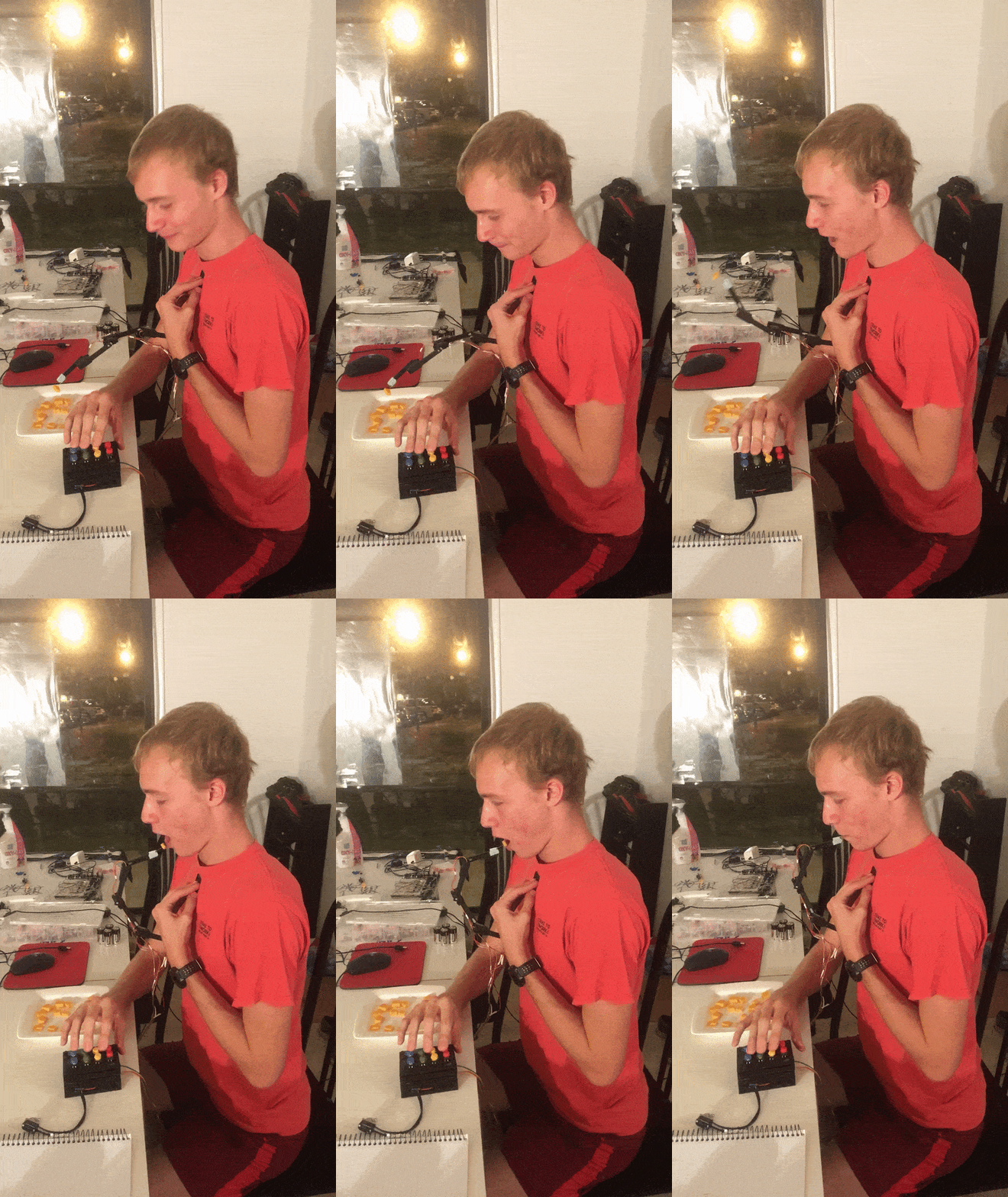
A test using the skeleton of the tie to pick up and eat cheese


GROUND-AIR HYBRID ROVER
In 2015, I led a team in Virginia Tech's annual Additive Manufacturing Vehicle Design Grand Challenge, a competition to design a rover that can both drive and fly that uses as few non-3D-printed parts as possible. We designed our rover to fit in a small 3D printer and unfold and snap together rapidly into its final form. I designed the chassis and the main unfolding wheels. The wheels can operate either folded for high torque or unfolded to grip and climb stairs. We finished 4th of 70 teams, with the fastest assembly time.
LIGHT SWITCHES
The tale of mankind is but a progression towards better ways of turning on lights. From fire to nuclear fission to the Clapper™, our achievement has compiled. Here are a few more ways to turn on lights.
As a freshman, I designed a system that uses a red light photosensor, an Arduino, and a servo to make a light switch controllable by a laser. Anyone at any point in the room could activate it with a laser pointer. My roommate, his bed far from the light switch, appreciated it.
I am currently making a system with an electret microphone and an Arduino that controls the angle of a servo to match changes in pitch detected by the microphone. Sound is read in in intervals of ~.25 seconds, Fourier transformed, and analyzed for changes in peak pitch relative to background noise over time. When no peak is found for long enough, the motor plays back the signaled motion. One use is a light switch that can be turned off or dimmed by singing or playing an instrument.

This is the final system with the skeleton inside the fabric of the tie. Because the tie is slightly bulky, we decided to always leave the knot tied. When worn, only the blue fabric is visible.